



Decoding “Politics–Public Finance” and the Future of Universal Health Coverage (UHC)
Prepared by Associate Professor Dr Theepakorn Jithitikulchai and Pacharee Wattanakulchai, Faculty of Economics, Thammasat University
The Faculty of Economics, Thammasat University, in collaboration with the SEARCH Network, the Saw Swee Hock School of Public Health, National University of Singapore (NUS), and the Takemi Program in International Health at Harvard University, organized an academic dialogue entitled “Dialogue on the Political Economy of UHC Financing.” The event aimed to provide a platform for policy and academic exchange on the political economy of health financing that shapes the direction and sustainability of Universal Health Coverage (UHC).
The dialogue was held on Tuesday, 27 January 2026, from 1:00–3:00 PM, at the 5th Floor Conference Room, Faculty of Economics, Thammasat University (Tha Prachan Campus), and livestreamed via Facebook Live: EconTU Official. Participants included policymakers, academics, health professionals, and students from Thailand and abroad. The objectives of the dialogue were to:
- Exchange and discuss key challenges related to resource constraints, inefficiencies, and the sustainability of health financing from political economy perspectives.
- Promote cross-country peer learning on practical fiscal approaches to strengthen and sustain fiscal space for UHC and the broader health system.
In his opening remarks, Assoc. Prof. Dr. Peera Charoenporn, Dean of the Faculty of Economics, Thammasat University, noted that although UHC is often perceived as a technical economic challenge—such as benefit package design, provider payment mechanisms, or cost containment—experiences from Thailand and other countries clearly demonstrate that UHC sustainability is inevitably shaped by political institutions, fiscal constraints, and policy decision-making processes. He expressed hope that this dialogue would broaden open and constructive discussion, enhance public understanding of policy trade-offs, and support policymaking that aligns with political realities.
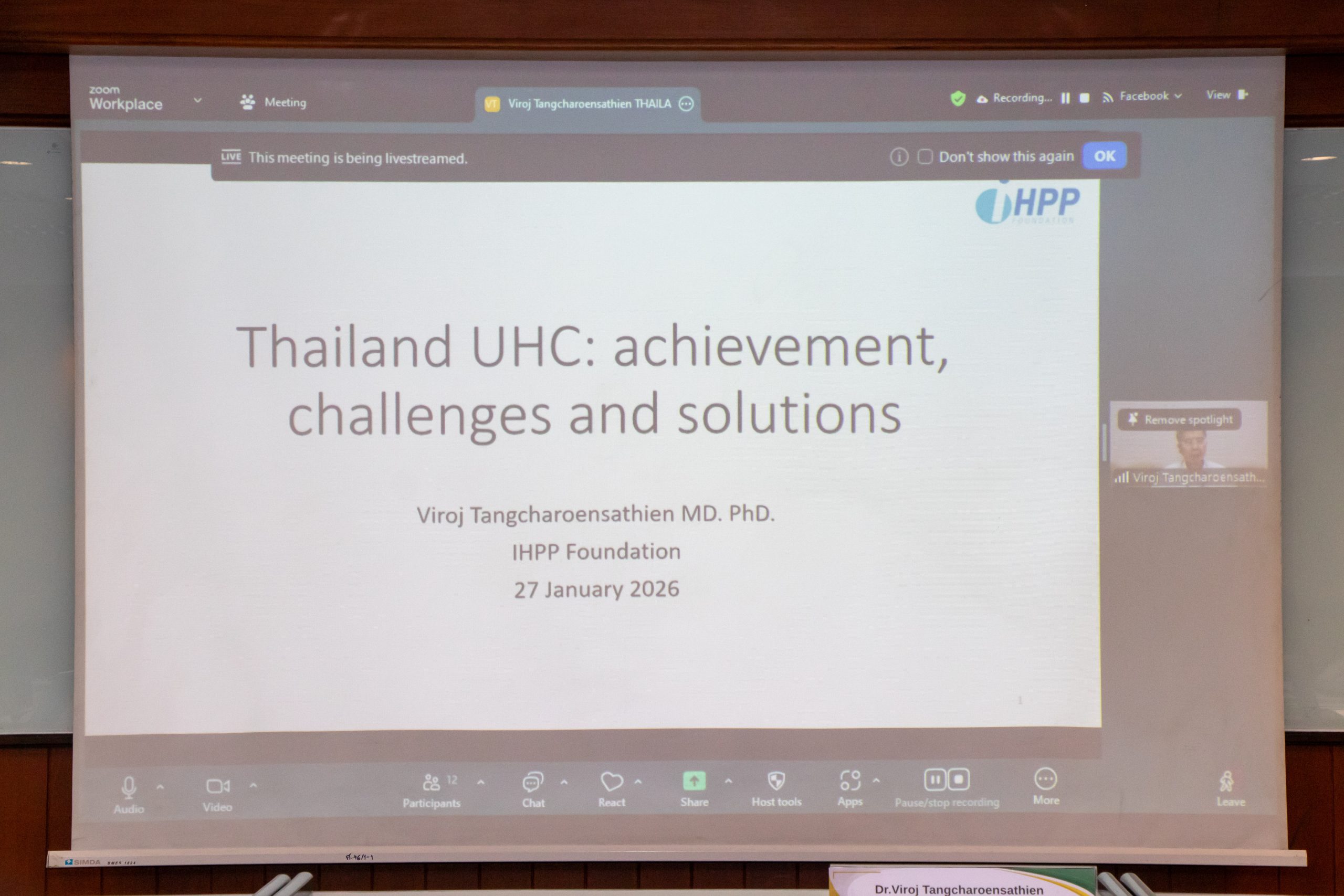
The event featured a keynote lecture by Dr. Viroj Tangcharoensathien, Senior Advisor to the International Health Policy Program Foundation (IHPP) and a key architect of Thailand’s UHC system, on “The Political Economy of UHC Reform in Thailand.” He shared lessons from advancing UHC under fiscal constraints and highlighted the institutional strengths that have enabled Thailand’s system to serve as a global example for over two decades.
Dr. Viroj emphasized that Thailand’s UHC system is strong in both efficiency and equity, grounded in evidence-informed policymaking. However, future challenges include fiscal constraints arising from Thailand’s transition to a super-aged society, declining birth rates, economic slowdown, and continuously rising health expenditures—combined with political pressures to increase health budgets without concrete revenue reforms. Under such economic and fiscal constraints, solutions cannot rely solely on increasing budgets, but must focus on improving system efficiency by reducing low-value care, strengthening governance, and improving public expenditure mechanisms. He stressed the importance of strong institutions and active civic engagement in sustaining a high-quality and equitable UHC system.
The second keynote was delivered by Dr. Jesse B. Bump, Executive Director of the Takemi Program in International Health at Harvard T.H. Chan School of Public Health, on “The Political Economy of Global Health in Historical Perspective.” He highlighted that while public health principles emphasize rights and equity, health systems in practice are shaped by power imbalances, unjust structures, and political influence.
Dr. Bump noted that insufficient health budgets in many countries, including those in ASEAN, are not solely the result of domestic fiscal constraints, but are rooted in global political and economic structures dating back to the colonial era. These structures involved the extraction of resources and value from poorer countries to richer ones, driven initially by profit motives without ethical considerations. Over time, knowledge systems were developed to increase efficiency and legitimize exploitation, supported by academia, and eventually normalized as cultural practices that render inequality and extraction socially acceptable.
In the current context of declining international aid, expanding Fiscal Space for Health has become a deeply political issue closely linked to power inequalities and resource allocation. Listening to public voices, making injustice visible, and questioning dominant paradigms are therefore essential to ensure that expanded fiscal space genuinely reduces inequality rather than merely increasing budget figures.
The meeting also featured a panel discussion on “Navigating Political Economies to Secure the Future of UHC Financing,” with distinguished panelists including:
- Prof. Dr. Praipol Koomsup, Former Dean, Faculty of Economics, Thammasat University, and leading Thai economist
- Dr. Jesse B. Bump, Harvard T.H. Chan School of Public Health
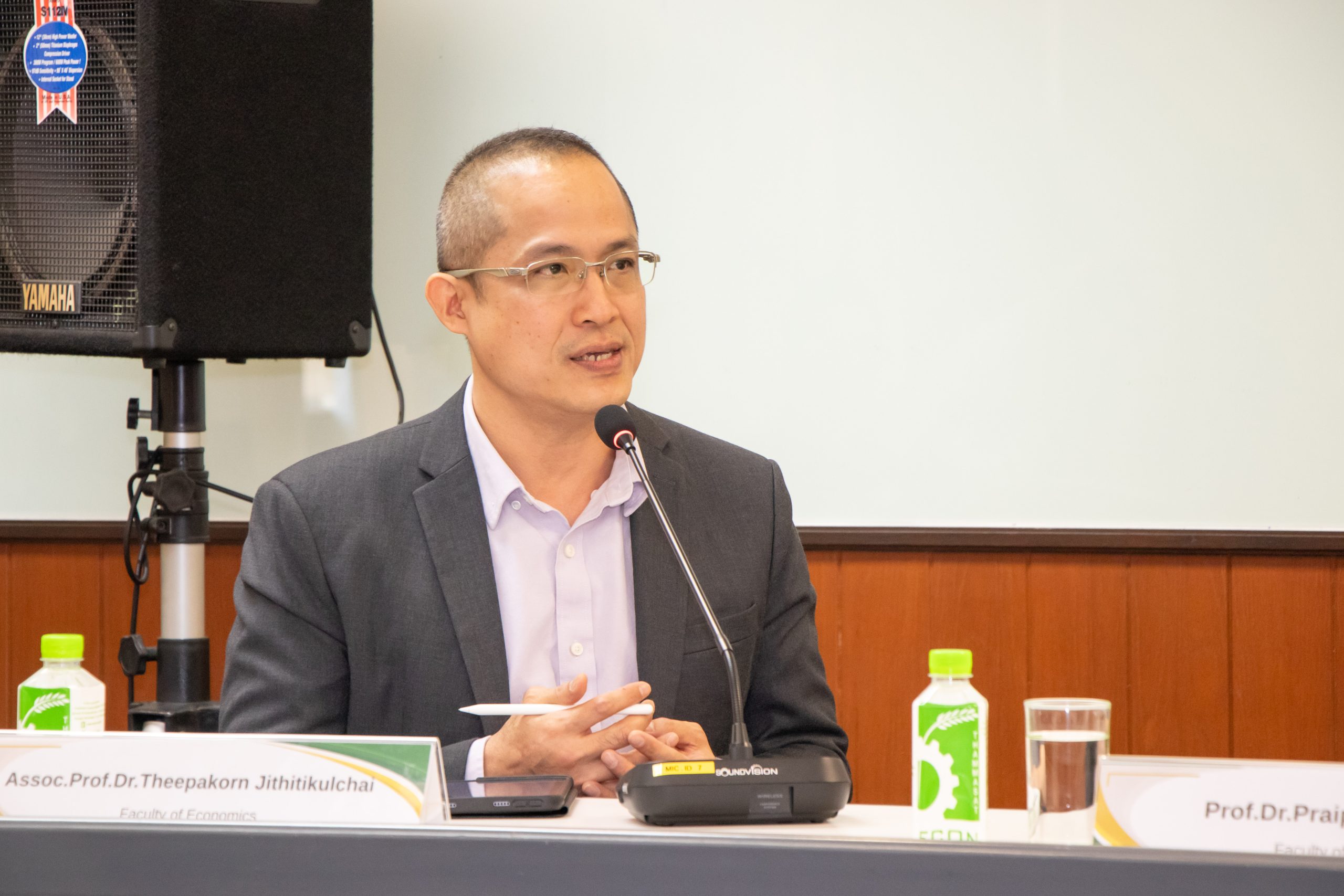
- Assoc. Prof. Dr Theepakorn Jithitikulchai, Faculty of Economics, Thammasat University
Prof. Dr. Praipol highlighted that Thailand and many countries face pressures from declining international aid, uncertainty in global trade, and rising defense expenditures. In this context, strengthening UHC sustainability requires increasing government revenue through tax base expansion, particularly through gradual increases in the value-added tax (VAT), to establish a stable revenue base for health spending.
Dr. Bump emphasized that the most fundamental determinant of UHC success is a shared social consensus between the state and its citizens. A system can only be sustained when there is genuine public demand and support. All countries face fiscal space constraints, and none have fully resolved issues of service quality and cost control. Therefore, health financing design must be adapted to each country’s specific economic, social, and political context.
Assoc. Prof. Dr. Theepakorn stressed that sustaining UHC requires both revenue expansion and budgetary reform. Beyond increasing fiscal space, governance improvements—particularly reducing corruption and enhancing resource-use efficiency—are critical. He proposed extending strategic purchasing mechanisms, a key strength of Thailand’s UHC system, to the Social Security Scheme and the Civil Servant Medical Benefit Scheme, alongside expenditure prioritization and revenue base expansion. While co-payments may help control costs and reduce unnecessary utilization, their implementation must be guided by equity and social protection principles to avoid burdening vulnerable populations.
Participants also emphasized that strengthening fiscal sustainability for UHC requires increasing government revenue through progressive tax reform based on ability to pay, while carefully considering the impact of VAT increases on low-income populations. The state should also focus on building long-term revenue sources for health system development, such as expanding tax coverage to the informal sector and reducing tax exemptions and deductions that disproportionately benefit high-income groups and large corporations.
Overall, there was broad consensus that sustaining UHC requires simultaneous improvements in resource-use efficiency and expansion of fiscal space. The system’s challenges extend beyond budgetary issues to involve broader public-sector governance structures.
The dialogue highlighted challenges in resource allocation, the politics of budgeting, and the role of public institutions in maintaining coverage, equity, and fiscal sustainability of UHC amid demographic transitions and rising health costs. The discussion aimed to generate policy proposals that are both analytically rigorous and politically and fiscally feasible, supporting the sustainable development of UHC in Thailand and Southeast Asia.
Download the presentation materials here.
